
Industrial facilities rely on fast, precise, and often powerful machinery to keep production moving. While all that equipment can lower labor costs and improve both product quality and consistency, it also introduces risk.
Moving parts, high-speed automation, robotics, pinch points, and flying debris or sparks can turn a routine workday into a serious safety incident if workers come too close.
Machine guarding exists to prevent that from happening. These physical barriers accomplish three crucial goals: keep people safe, protect expensive equipment, and help companies stay compliant with safety standards.
At KABTech, we work with engineering departments, plant managers, and project leaders who all share a similar challenge: They know they needmachine guarding, but they aren’t sure which system is right or how to fit one into a busy facility.
Our job is to remove the guesswork. With 40 years of experience, customer-driven support, and a custom-built-to-order approach, we help teams design the right guarding layout from day one.
Machine guarding involves the use of barriers, devices, and other safety measures designed to protect workers from hazardous moving machinery parts. It’s required anywhere personnel might be exposed to:
Guarding can take different forms (e.g., physical barriers, two-hand controls, safety devices), but in industrial and manufacturing environments, physical barriers remain the most dependable option.
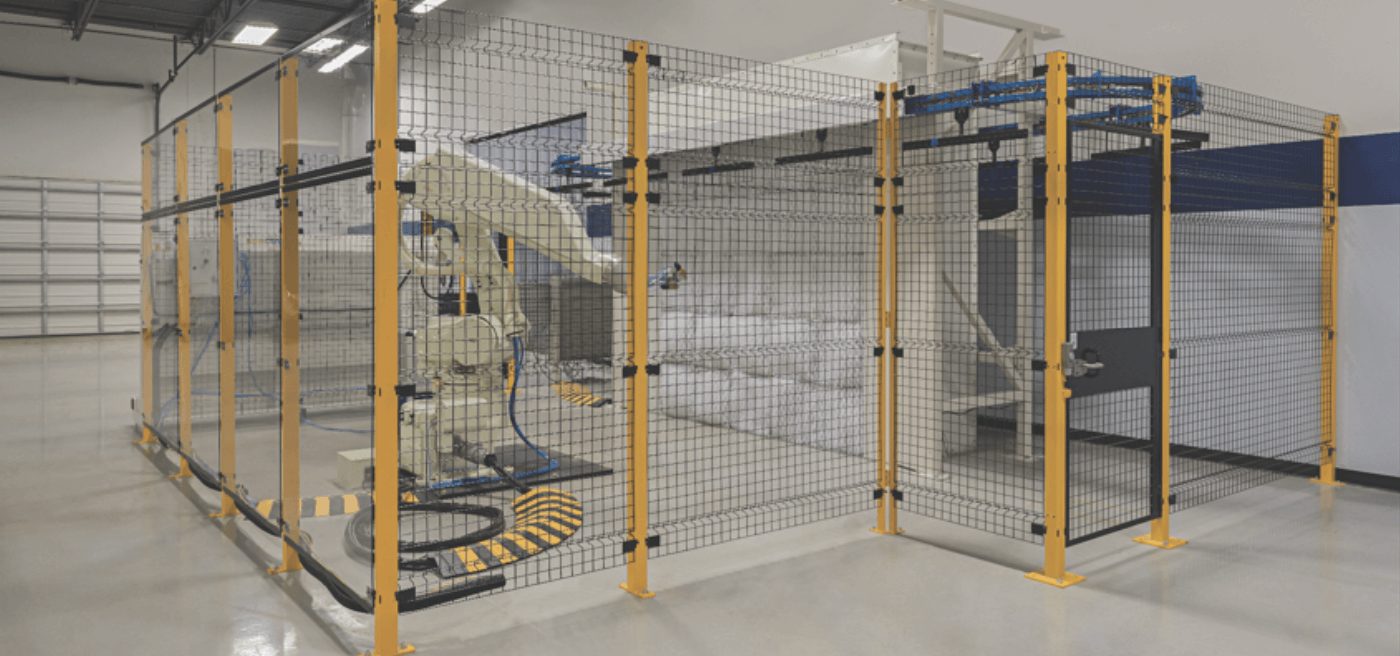
Durable and strong, wire mesh equipment enclosures help prevent serious workplace injuries and fatalities while providing easy access to guarded machinery.
Unlike solid walls, mesh panels let supervisors monitor equipment without directly stepping into hazardous zones. They also allow for better airflow around motors and electrical components, improve overall visibility, and reduce the risk of entrapment or blind spots.
These features make wire mesh partitions one of the most widely used guarding solutions in high-volume facilities.
Many engineering teams turn to customizable wire mesh partitions because they strike the right balance between strength, flexibility, and long-term value. Mesh guarding offers:
- High structural integrity: Steel mesh panels mount securely to rigid posts, forming a tough barrier that resists impact and vibration.
- Clear sightlines:When managers have an unobstructed view of machinery, they can spot issues faster and ensure operations remain safe.
- Airflow and heat control:Mesh panels feature an open-grid design that allows natural cooling around motors and automation systems. This is vital for preventing accidental fires or explosions, along with preserving the equipment’s lifespan.
- Modular design:Panels can be reconfigured if equipment changes, expands, or shifts over time.
- Compatibility with safety systems:Our panels integrate easily with keyed locks, interlocks, sliding or hinged doors, and controlled access points.
While other suppliers might offer alluring “straight-off-the-shelf” kits, KABTech delivers custom-built systems tailored precisely to your facility’s specific needs.
Plus, you won’t be stuck with a set design after installation. Our modular systems are engineered to adapt and grow with you. They’re also made from the highest-grade materials, meaning that with proper maintenance and adherence to safety guidelines, our machinery enclosures withstand heavy use and last for decades.
Many sectors now require high-speed automation, robotics, and advanced material handling to stay efficient. While every facility has its own unique layout and risk profile, certain industries rely heavily on guarding more than others due to the nature of their equipment and processes:
- Manufacturing: Protects workers from conveyors, robotic arms, rotating tools, and automated assembly equipment.
Automotive & Heavy Equipment: Guards welding cells, stamping machines, and high-force robotic systems. - Food & Beverage Processing: Secures slicers, packaging lines, and high-speed filling equipment while maintaining airflow and clear sight lines.
- Warehousing & Distribution Centers: Encloses sortation systems, conveyors, palletizing robots, and Automated Storage and Retrieval System (AS/RS) zones to prevent unauthorized entry.
- Metalworking & Fabrication: Shields operators from Computer Numerical Control (CNC) machines, press brakes, laser cutters, and flying metal debris.
- Electronics & Plastics Manufacturing: Guards injection molding equipment, pick-and-place robots, and automated assembly systems.
If your team needs to prevent injury from machinery with wire safety enclosures, machine guarding is often the safest and most efficient solution.
While wire mesh security cages are often the preferred choice for many facilities, solid panel guarding is still a great option for concealing items, blocking noise, and limiting access to machinery. It all depends on your main goals and overall setup.
The feature comparisons below offer a helpful starting point for choosing the right guarding type:| Feature/Benefit | Wire Mesh Guarding | Solid Panel Guarding |
|---|---|---|
| Visibility | Excellent visibility for supervision and troubleshooting | Limited visibility; operators must enter the enclosure to inspect equipment |
| Airflow | Allows natural air to flow through, ideal for motors, electronics, and robotics | Restricts airflow; may increase heat buildup |
| Fire Detection & Suppression | Mesh allows for easy detection and sprinkler coverage without interruption | Excellent at containing fire hazards; may require special design considerations for fire suppression |
| Debris Containment | Effective at absorbing impact, but not at containing airborne matter | Better at containing light debris, sparks, or fluids |
| Weight & Installation | Lightweight, easy to install, and reconfigurable | Heavier; more rigid and permanent |
| Customization | Highly flexible; ideal for irregular layouts, long conveyor runs, and multi-level equipment | Customizable but less adaptable to unusual footprints |
| Maintenance Access | Easy to see through; inspections are much simpler | Requires door openings or even panel removal for visual checks |
| Best For | Robotics, automation, conveyors, AS/RS systems, and general machinery | Applications requiring light containment, privacy, visual barriers, or noise reduction |
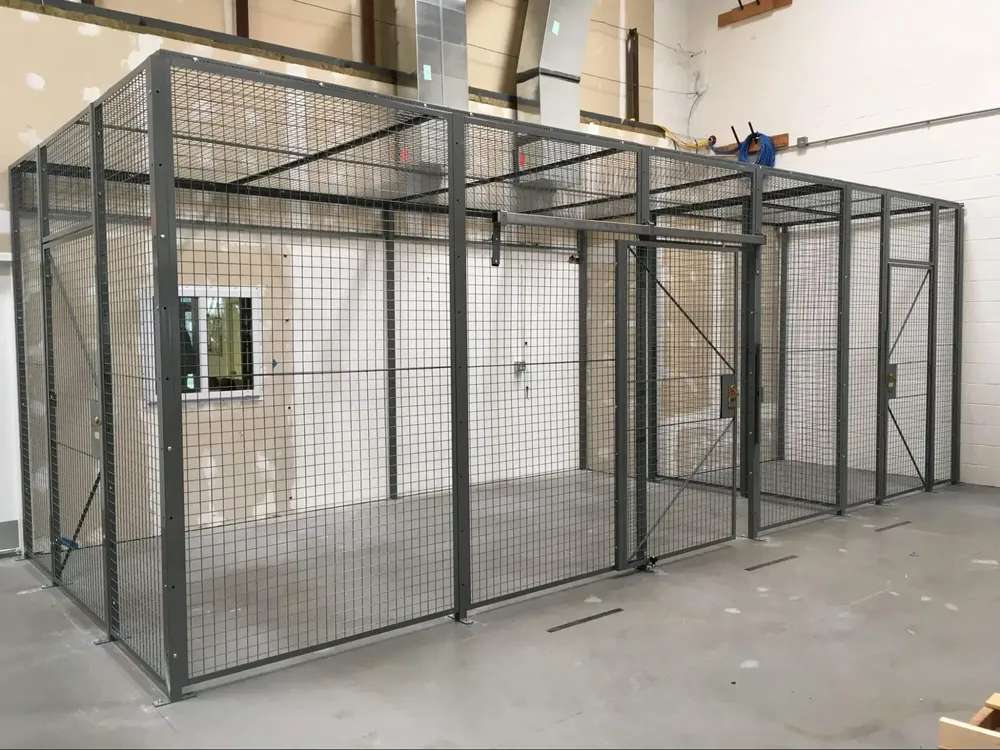
Mesh also weighs less and is generally easier to reconfigure. That makes it a smarter choice for facilities expecting future growth or equipment changes. Not sure which type you need? Interested in combining both guarding types into a single system? KABTech offers both wire mesh and solid panel machine guarding solutions to match your equipment, layout, and safety requirements. Whether you need clear visibility and airflow or a more enclosed barrier for noise and debris control, our team designs and builds every system to order, ensuring a precise fit and long-term durability in your facility.
There’s a lot to consider when selecting the right machine guarding solution for your business. After deciding between wire mesh and solid panels (or a mix of both), we recommend taking the following features into account:
Your facility may need new or expanded machine guarding if:
- Automation was added or upgraded recently.
- Near-miss incidents have occurred or increased.
- Workers pass too close to equipment.
- Existing guards are outdated or pieced together.
- Production lines have shifted or expanded.
- Frequent system breakdowns have been documented.
- Maintenance costs are continuing to get more expensive.
- Current guarding doesn’t comply with the latest safety standards.
Does any of the above apply to you? Think you might have a unique situation? Reach out to one of our KABTech representatives. We’re happy to answer any questions you have and typically respond within 24 hours (if not sooner).